
Internal structure of the earth


1. the earth
2. Seismic waves
3. Nature of earthquake waves
4. The crust:
5. The mantle and core:
Internal composition of the earth

The shape of the earth is a spheroid having a radius a mean equatorial radius of 6373 km and a polar radius of 6356.9 km so the earth is a globe with a radius of 6371km. the earth comprises of several layers, which are distinguished by their physical (thickness, density, depth , temperature ) and chemical properties (metallic content) and rock. The three major layers of the earth are:
1. The crust : It is the topmost layer of the earth. Its thickness over the oceanic areas is 5- 10 km, whereas in the continental areas it is 35 km, in the orogenic belt( mountainous ) it is 55-70km. It forms about 1 % of the earth by volume. The upper crust from a depth of 2 – 10 km is mostly sedimentary rocks.The crust of the earth is subdivided into two sub layer as-
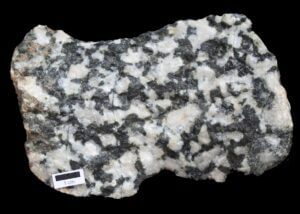
a) Sial: It is known as the Upper continental crust and consist of all types of rock – igneous, metamorphic and sedimentary rock which are exposed at the landmass. It is rich in silica and aluminum and is mainly granitic rocks.
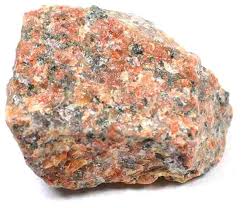 fig : Granite rock
 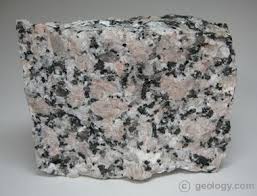 Sial and Sima layer is separated by a boundary known as Conrad discontinuity located at 11km.
b) Sima: lt is also known as Lower continental crust .Its thickness is 22km and is rich in silica and aluminum . it is divided into two parts-
- Outer Sima: It extends from a depth of 11 -19km and composed of rock of intermediate composition.
- Inner Sima: It is located up to a depth o f 19 – 33 km and composed of rock of basic to ultra basic composition
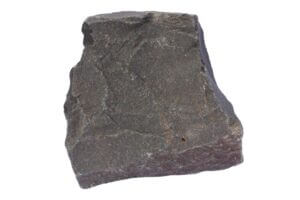
2. Mantle: Mantle is separated from the overlying crust by Mohorovicic discontinuity which is first order discontinuity, its thickness is about 2865km. it forms about 83% of the earth by volume and 68% by mass. The velocity of S and P waves increases with depth that mneans the mantle is more dense that of the crust.
It is the source region of most of the earth’s internal energy and of forces responsible for ocean floor spreading, continental drift, orogeny and major earthquakes. It is composed of olivine and pyroxene mineral.
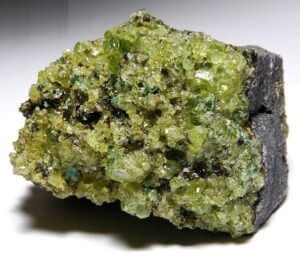
It is believed that the upper mantle is composed of 1 parts basalt and 3 parts ultra mafic rocks known as Pyrolite. The mantle is divided into two layers –
a) Upper mantle: This layer is divided into two-
- Gutenberg layer: It lies between Mohorovicic discontinuity (33km) and to a depth of 410 km with a decrease in seismic velocity. The crust and the upper part of Gutenberg layer is called the lithosphere which is also called tectonic plates. The lithosphere is underlain by asthenosphere ( asthenes in Greek word – no strength) which is a layer of no strength to resist deformation with low seismic velocity. The asthenosphere is lies between 70 – 220km depth so the lithosphere is separated from mantle by the asthenosphere. The lithospheric plates are floating above the asthenosphere.
- Golitsyn layer: The lower part of the mantle is known as Golitsyn’s layer , there is a sharp rise in seismic velocity. It extends from 410km -1000km
b) Lower mantle: The lower mantle extends from 1000km to the core boundary. The lower mantle is again consist of two layers-
- 1000- 2700 km: P waves reach its maximum at this layer
- 2700 – 2900km: At this layer P waves decreases due to transition layer
3. Core : The core and the mantle is separated by Gutenberg Weichert discontinuity and extends to the centre of the earth. It forms about 17% of volume and 34 % of the mass of the earth. It consists of three layers-
- Outer core: It extends from 2900 – 4982km . it is considered to be in a state of homogeneous fluid as it does not transmit S-waves.
- Middle core: It is a transition layer, extends from 4982 – 5121 km. the material is in a fluid to semi fluid condition.
- Inner core : It is believed to contain metallic nikel an iron called nife. It extends from 5121 to the centre of the earth, i.e. It is probably solid with a density of about 18 with temperature of about 60000C.
Primary waves /compressional waves / P-waves :
They are longitudinal waves which is same as sound waves while other seismic waves are all transverse waves. They are called primary waves because they are faster than other seismic waves and are arrived at a distant point before others. P waves are made up of compression and rarefactions of the rock inside. These waves compress and expand the ground like a toy as they move through it. These waves can travel in solid ,liquid and gases media. They have short wavelength and high frequency. Velocity in water 1.5km/s , in air it is 0.3 km/s, in earth ‘crust 5-7km/s , in mantle and core 8km/s.
- Shear waves / Transverse waves /secondary / S –waves :
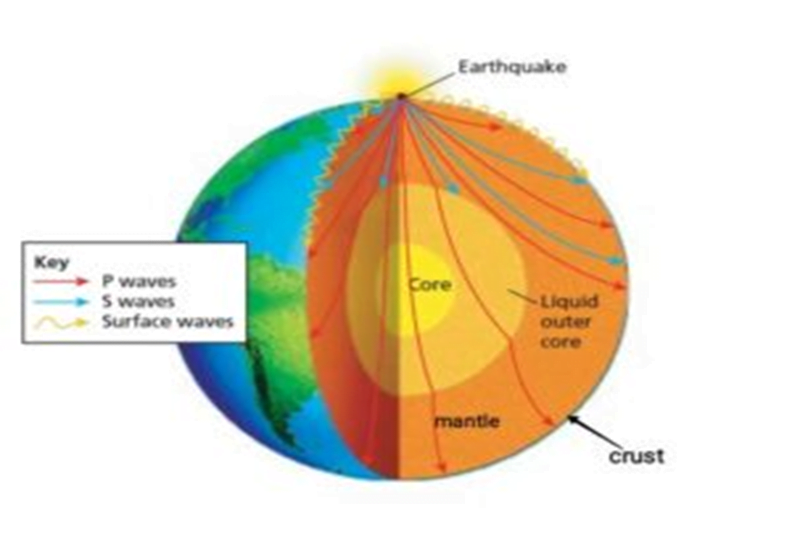
They can travel only is solid , but not in air and water or magma . Parts of the core is liquid they cannot pass through it like the P waves . Therefore S waves cannot be detected on the side of the Earth opposite an earthquakes . Scientist on the other side of earth opposite the earthquake cannot detect S waves . These are transverse waves with crest and trough. S waves shake the earth up and down and side to side as they moves through the rock .The velocity is 2.5- 3 in solid core , 3-4km/s in crust , 4.5 km/s in the mantle. They are slower than P- waves , they have short wavelength and high frequency.
P and S waves are called body waves because they occur within the earth’s body. when S and P waves reaches the earth’s surface they create surface waves
4.Rayleigh waves / surface waves / R waves:
It is also transverse waves and occur only on earth’ surface . The particle motion is both in the direction of propagation as well as perpendicular in vertical plane
Surface waves are a combination of transverse and longitudinal waves that travel along the surface of the medium. surface waves travel slower than Body waves but they can cause the most severe ground movements. they are the combination of up and down and side to side motions making the ground roll like oceans and waves
 .
.